Binary Tree

Binary Tree is a tree in a hierarchical
data structure (one to
Binary tree is a tree with the condition that each node (node) can only have a
maximum of two subtree and the two subtree must be separate. Each node in a
binary tree can have at most two children, the child specifically named left
and right.
Binary trees can also be stored as implicit data structures in arrays, and if
the tree is a complete binary tree, this method does not waste a place. In this
tight arrangement, if a node has index i, its child can be found at index 2i +
1 and 2i + 2, even though the father (if any) is found at the index floor
((i-1) / 2) (assume the root has an empty index).
Binary tree is a tree with the condition that each node (node) can only have a maximum of two subtree and the two subtree must be separate. Each node in a binary tree can have at most two children, the child specifically named left and right.
Binary trees can also be stored as implicit data structures in arrays, and if the tree is a complete binary tree, this method does not waste a place. In this tight arrangement, if a node has index i, its child can be found at index 2i + 1 and 2i + 2, even though the father (if any) is found at the index floor ((i-1) / 2) (assume the root has an empty index).
Binary Search Tree

Binary
Search Tree is an ordered tree (ordered Binary Tree). Binary Search Tree is
also often called a Sorted Binary Tree which functions to store information on
names or numbers that are stored in memory. With this data is divided into two
by finding the midpoint as a benchmark. A binary tree consists of a main node
called the root. Then from the root there are the left and right. Data is stored
after the root is stored based on the value of comparison with the root.
Ordering can be done if BST is traced (traversed) using the in-order method.
Details of this search process will be discussed at the next meeting. Data that
has been arranged in the BST data structure can also be searched easily and has
an average complexity of O (log n), but requires a time of O (n) in the worst
conditions where BST is not balanced and forms a linked list
Binary
search tree allows fast searching, addition, also deleting the data contained
in it, can also be used as an implementation of a number of dynamic data, or
search for data tables by using key information.
In order
for the data to actually be arranged in the BST data structure, the two rules
that must be met when the data are arranged in the BST are as follows:
All data
in the left sub-tree of node t is always smaller than the data in node t
itself.
All data
in the right sub-tree of node t is always greater or the same as data in node
t.
Hash
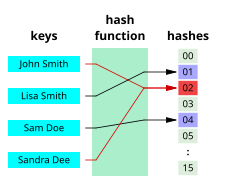
Hash or Hashing means decapitating and then combining.
The hash uses main storage memory in the form of arrays with additional
algorithms to speed up data processing. A hash is a method that directly
accesses records in a table by performing an arithmetic transformation on the
key that is the address in the table.
Hashing is used as a method for storing data in an array
so that data storage, data search, data addition and data deletion can be done
quickly.
The hash function must be stable (referential
transparent), meaning, if it is called twice by exactly the same input (for
example, a string containing the same character sequence), then it must give
the same result.
Tracking using a hash consists of two main steps, namely:
Calculating Hash Functions
The Hash function is a function that changes keys to
addresses in a table. The Hash function maps a key to an address in a table.
Ideally, different keys should be mapped to different addresses. In fact, there
is no perfect Hash function. Most likely what happens is that two or more
different keys are mapped to the same address in the table. This event is
called a collision. That's why the next step is needed, namely collision
resolution (collision resolution).
Collision Resolution
Collision resolution is the process of handling the
occurrence of two or more keys hashed to the same address. The way to do this
if a collision occurs is to find the empty locations in the Hash table in
order. Another way is to use another hash function to find the empty location.

Comments
Post a Comment